How to Hire Forward Deployed Engineers: A 2026 Guide for Enterprise AI Teams
How to hire forward-deployed engineers: when you need an FDE, how to scope and source one, interview questions, a scorecard, and 2026 pay data.

Alyssa Sutton
5 min read
How to hire forward-deployed engineers: when you need an FDE, how to scope and source one, interview questions, a scorecard, and 2026 pay data.

If you want to hire forward-deployed engineers, start by deciding what the role must deliver, because the title now covers three different jobs. About 1,000 FDE job postings found that roughly 60% describe a true builder who ships production code, about 30% describe a sales engineer under a new name, and the remaining 10% describe internal tooling work. Hire the wrong one, and you pay a senior engineering salary for demos.
This guide covers the full process. It starts with whether you need a forward-deployed engineer (FDE) at all, then moves through scoping, sourcing, interview questions for FDE candidates, a weighted scorecard and current pay data, and ends with the point where renting embedded engineers is the smarter move. It is written for CTOs, heads of AI, and operations leaders who are about to open a requisition for a role their organisation has never hired before.
To hire forward deployed engineers, define the customer problem and the success metric first, scope the role as an engineering position that is roughly 60% building and 40% customer-facing, and source from teams that already ship code inside customer environments. Then test candidates with a real coding exercise, a messy-data exercise, and a live scoping conversation, score them against a weighted scorecard, and benchmark pay against your senior product engineers rather than against sales engineers.
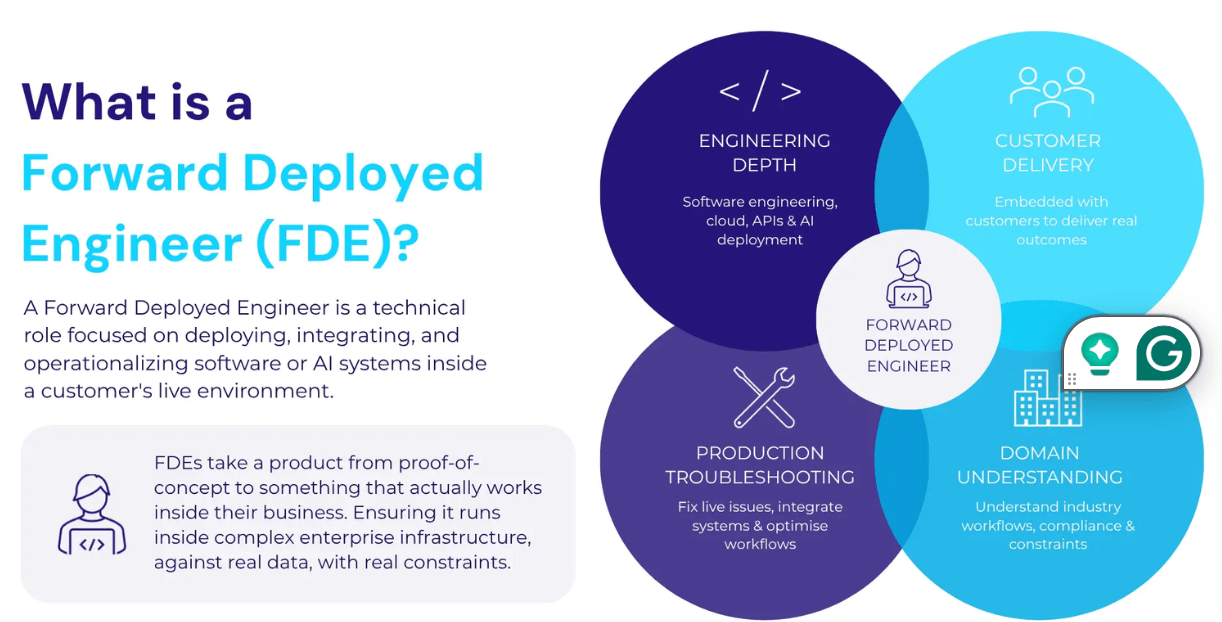
A forward-deployed engineer (FDE) is a software engineer who embeds with a customer, works inside the customer's systems and data, and ships production code that makes a product or AI system work in that customer's real environment. The "forward" refers to working at the point of delivery rather than at headquarters, and the "deployed" refers to being placed with the customer, often on site, for weeks or months.
While Palantir devised the role nearly two decades ago, the term traces its recent popularity to AI companies that need highly technical products to work inside legacy workflows. The FDE builds the last mile: integrations, data pipelines, evaluation harnesses, and custom workflows that the core product cannot cover on its own, while remaining an engineer who writes and debugs production code.
An AI forward-deployed engineer is an FDE who specialises in connecting models and agents to enterprise data and workflows, building retrieval, evaluation, and tool-calling layers against a customer's real systems and feeding what breaks back into the product. In 2026, this is the profile most buyers actually need, and Bloomberry's data shows why: 35% of FDE postings mention AI agents and 31% mention working with large language models.
The confusion comes from title inflation, so it helps to compare the roles side by side.
The practical test is simple. If the job carries a quota or commission, or if the person hands off after the deal closes, it is a sales engineering role. Bloomberry found that 70% of FDE postings mention equity, 8% mention on-target earnings, and none of the analysed postings carried a quota.
Demand has moved faster than the supply of people who have done the job. There is a 1,165% year-over-year rise in FDE postings between January and October 2025 against the same period in 2024.
Money is following the postings. An analysis of the FDE boom totals $9.75 billion committed by five AI companies in twelve months to forward-deployed engineering. That figure includes $4 billion for OpenAI's standalone Deployment Company, $2.5 billion at Microsoft, $1.5 billion for an Anthropic joint venture, $1 billion at Amazon, and $750 million in a Google Cloud partner fund. Salesforce, separately, has committed to 1,000 FDE roles.
The reason is straightforward. Models now work in demonstrations, but most enterprises cannot install, integrate, and operate them without engineers sitting next to the data. That is also why the hiring market is hard: you are competing with the model providers themselves for a pool of candidates that barely existed three years ago. If you would rather have the capacity without the cycle, JADA's FDE as a Service places embedded engineers on your agent roadmap directly.
Tell us what you need. We will build, deploy and manage the AI Agent for you.
Most failed FDE hires begin with a wrong diagnosis. Founders open a search for an FDE and discover, once they describe the week, that they need either a conventional software engineer or an implementation consultant. The role is expensive, travel-heavy, and hard to fill, so it deserves a diagnostic before a requisition.
Three conditions suggest an FDE is the right hire:
And then ask these questions:
If the honest answer to the last question is deals closed, you are hiring a sales engineer. If the problem is that employees have licences but no habits, you need an adoption programme rather than an engineer, and JADA's AI adoption programme addresses that case directly.
And if your use cases are approved but your team is at capacity, you can embed a JADA FDE and get to market faster.
There are four ways to get FDE capacity, and each fails differently. Comparing them before you open a requisition saves months.
Most mature teams end up with a mix: a small permanent FDE core for strategic accounts and rented capacity for peaks. First Round's operators reached a similar conclusion, reserving FDE effort for their largest customers and systematising the rest. For a framework on judging partners rather than people, see JADA's guide on how to choose an AI agent deployment partner.
The process below assumes you have passed the diagnostic and decided to hire directly. Each step produces something you can reuse for the next role.
Write one paragraph describing the customer problem the hire will solve and the number that will move, such as deployment time, adoption, or incidents. A role defined by activity ("work with customers") attracts candidates who like activity. A role defined by an outcome ("take agents from approved use case to production in six weeks") attracts people who ship.
State the split explicitly. A workable default is about 60% building and 40% in front of customers, and "in front of customers" should be defined as discovery sessions, working alongside the customer's engineers and presenting to a senior sponsor. Place the role in engineering. Bloomberry found that 45% of postings describe FDEs as their own dedicated team and 38% place them in the engineering organisation, against 14% in sales. Set the level with engineering rather than sales, because FDEs compare pay with product engineers and each other.
A generic list of responsibilities attracts generic candidates. Describe two or three real deployments instead, so strong candidates recognise the problem shape. Name the constraints that scare off the wrong people and attract the right ones. A good FDE job description includes:
The title is young, so title-based searches exhaust themselves within weeks and miss most of the pool. Bloomberry's look at 100 FDE profiles shows where people come from: 45% were software engineers, 22% solutions engineers or architects, 15% data engineers or scientists, 10% technical consultants, and 8% founders or early startup employees. Five pools are worth working in practice:
Use a 30-minute screen to establish one thing: has this person deployed something into a customer's production environment? Ask for the last time they did, what broke, and how they fixed it. Listen for a named problem, a specific failure, and a timeline. A candidate who describes work only in team terms ("we built") or has never touched a customer's environment is not an FDE yet, however good their résumé looks.
Never skip the coding evaluation because the role is customer-facing. It is the most expensive shortcut in this search, and it is how teams end up with an excellent communicator who cannot ship. Use four exercises, in this order:
For agent roles, add a review of oversight design. A candidate should be able to explain where a human approves, where an agent escalates, and what the audit trail records. JADA's piece on human in the loop versus human on the loop is a useful reference for the discussion.
Score every candidate on the same card, independently, before the panel compares notes. The scorecard later in this guide gives the criteria and thresholds. Independent scoring protects against the most common failure in FDE interviews, which is that the most fluent talker wins.
Strong FDE candidates tend to decide on problem quality and autonomy before pay. Present the specific customers, the first deployment, the person they will report to, and what they will own. Then make the offer quickly, because the pool is small and the labs are hiring from it.
The technical stack is conventional, and the differentiator is range. Most FDEs are mid-career: 60% of postings that state experience ask for three to five years. Because they build dashboards and workflows as well as back-end services, treat full-stack range as an asset rather than a bonus.
For AI deployments, the bar shifts towards agent engineering. Look for candidates who have built retrieval over a customer's real corpus, tool and function calling with scoped permissions, evaluation harnesses on customer data, and defined fallback behaviour for when a model or tool fails. They should also be able to explain how they would observe the system after go-live and who operates it at 3 am. If your own roadmap is about building such agents, JADA's custom AI agent development practice shows what production-grade looks like.
The operators First Round interviewed named five traits that recur in the best FDEs:
Looking for forward-deployed engineers for your team, without adding a headcount? JADA embeds talent forward-deployed engineers into your team, flexibly. Speak to our experts today!
Good interview questions for FDE roles test lived experience, not knowledge of terms. Use open prompts, ask for specifics, and listen for the signals below. The questions are grouped by what they reveal.
Deployment experience
Technical depth for AI agents
Discovery and communication
Scope and product judgement
Composure and commitment
Skip the hiring cycle: JADA’s forward deployed engineers join your team and start shipping the agents already on your roadmap.
Score each criterion from 1 to 5 independently, multiply by the weight and total the result. The weights below favour evidence of shipping over fluency.
Treat 4.0 and above as a strong hire. A score from 3.5 to 3.9 is a hire only if there is no red flag in the two highest-weighted criteria, and anything below 3.5 is a pass.
Pay depends on whom you compare, so use three datasets and understand why they differ. All figures are US base salaries in USD.
The spread comes from three sources. First, "FDE" is a title rather than a level, and the same employer can advertise tracks from security to infrastructure at very different bands. Second, equity sits outside most bases: Bloomberry found it mentioned in 70% of postings. Third, the frontier labs are paying cash premiums to hire from a small pool. Recruiting from Scratch advises that offers below $160,000 will struggle to attract experienced candidates.
Budget beyond base for equity or bonus, travel, recruiting fees, tooling, and a ramp-up period during which the engineer is not yet billable to a customer problem. Outside the United States, benchmark against your local senior product engineer band in the UK, the EU, Canada, or Japan instead of converting dollars directly, because equity norms, employer costs, and notice periods differ.
Roughly three in ten postings that use the FDE title describe a rebranded sales role, so be explicit that the person ships code and is measured on systems in production.
A customer-facing role is not a reason to lower the technical bar. The best FDEs could pass a software engineering loop, and the loop is how you protect your product.
Without a senior person who owns the route from field work to roadmap, the work is invisible to the product team and the hire churns.
First Round's operators reserved FDEs for the largest accounts and made smaller deployments repeatable. Treating FDE as an all-or-nothing model turns it into a services business inside a software company.
Ambiguity about travel is a common reason accepted offers unwind. Put the number in the posting and the offer.
In regulated sectors such as banking, insurance, and healthcare, security review, data residency, and audit requirements decide how a deployment is built. Ask candidates how they have worked within them.
Composure under a failing demo matters more than a smooth pitch, and a fluent interviewer is not necessarily a strong builder.
A well hired FDE can still fail in the first quarter if the onboarding is vague. A workable plan has three stages:
For the production side of that plan, JADA's AI agent deployment checklist covers readiness, controls, and handover. Review the engineer's output with your CTO weekly in the first quarter, and set a regular slot where field learnings are traded for roadmap decisions, otherwise, the feedback loop never starts.
FDE as a service is an engagement model in which a specialist firm supplies forward-deployed engineers who embed in your team, build and ship the agents or integrations on your roadmap, and hand over the result, without you running a hiring cycle. It suits teams whose use cases are approved but whose roadmap is held back by capacity or expertise.
The trade-off is control against speed. Hiring directly builds permanent capability but takes months and carries scope risk, while renting gives you working engineers quickly and lets you scale up or down. The strongest arrangements are explicit about handover so that your own team can run what the partner builds. JADA's complete guide to FDE as a service explains the model in more detail, and its guide to AI agent accelerators shows how pre-built components shorten the first deployment.
If you’ve decided that renting beats hiring, the next question is who you let into your team. JADA’s forward deployed engineers embed directly in your team, work to your roadmap and ship the agents you have already approved. You don’t run a requisition, a search or an onboarding programme, and you don’t add permanent headcount. Because the model is a monthly fee per FDE or per expert pod, you scale capacity up when the roadmap fills and down when it doesn’t.
Everything JADA’s engineers build for your engagement, including the custom code, belongs to you. Agents are built inside your own cloud, data and identity controls, with human approvals, escalation triggers and audit trails designed in from the start. JADA also picks the right technology for each task, which reduces dependence on any single provider. JADA is a member of the Anthropic Claude Partner Network, and clients describe the engineers as talented, collaborative and easy to embed in their own teams.
That mix gives you the speed of renting without being locked in. Your team gets a structured handover, so you can run what the engineers build or keep them on. If you want the engineers and the strategy, JADA’s custom AI agent development team maps your workflows and scopes the build, and a managed desk can monitor quality, cost and adoption after launch.
Want to get started? Book a scoping call with our experts today!
Forward deployed engineers embed with a customer, learn the customer's systems and data, and write production code that makes a product or AI system work in that environment. Typical work includes building integrations, designing data pipelines, tuning agents against real workflows, diagnosing production failures, and feeding what they learn back to the product team. Bloomberry's postings analysis found that working directly with customers (55%), building and deploying AI and machine learning systems (37%), and integrating systems and APIs (32%) are the most common responsibilities.
In the United States, advertised base pay for forward-deployed engineers ranges from about $90,000 to $320,000, with most core engineering postings between $125,000 and $300,000. Posting-based medians sit between roughly $174,000 and $195,000, with the middle half of postings at $160,000 to $215,000, and equity is common on top. Pay varies by employer, track, and seniority, and the frontier AI labs sit at the top of the range.
Run a real coding exercise, a messy-data exercise, a live scoping conversation with an interviewer playing a non-technical stakeholder, and a discussion of what belongs in the product. Score each candidate on a weighted scorecard that favours production deployment evidence. Useful questions include asking about the last deployment into a customer's production environment, how the candidate would handle a wrong agent 15% of the time one week after launch, and where a human should approve an agent's actions.
A forward deployed engineer writes production code in the customer's environment and is measured on systems shipped. Where as, a sales engineer supports the sale through demos and technical validation and is usually measured on deals. FDEs generally report into engineering or product, whereas sales engineers report into sales and often carry quota-linked pay. In Bloomberry's postings sample, none of the FDE roles were quota-carrying.
Hire directly when forward deployed engineering is a permanent capability tied to your product, and you can wait for a search. Use FDE as a service when your use cases are approved, your roadmap is waiting for capacity, or you need to test the model before committing headcount. Many teams combine the two: a small permanent core for strategic accounts and rented engineers for peaks.

