Human in the Loop vs. Human on the Loop: How to Choose for AI Agents
Human in the loop means a person approves each action. Human on the loop means a person supervises and steps in. Compare both and learn how to choose.

Emily Davis
5 min read
Human in the loop means a person approves each action. Human on the loop means a person supervises and steps in. Compare both and learn how to choose.

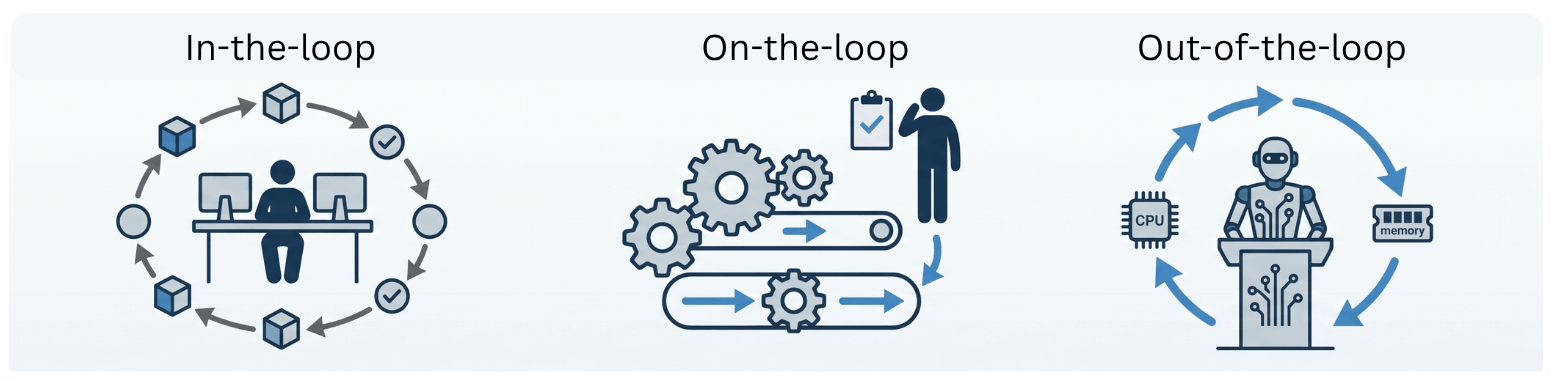
Human in the loop vs. human on the loop (or human on the loop vs. human in the loop), in one paragraph: in the loop, the AI proposes, and a person decides before anything happens. On the loop, the AI decides and acts within limits while a person monitors and can intervene or stop it. In the loop trades speed for control. On the loop trades some control for speed and scale. Most production AI agents need both, applied to different actions.
If you are deploying AI agents and are unsure where to start, the safest default is to begin in the loop and earn your way to on the loop. The rest of this guide explains how, and it is the same approach we use when we build and manage AI agents for enterprise and government teams.
Human in the loop (HITL) is an oversight model in which a person reviews, approves, edits, or rejects an AI system's output or proposed action before it takes effect. The AI cannot complete the step alone. The workflow pauses at a decision point until a human responds.
The word "loop" refers to the cycle an AI system runs through: gather information, decide, act, observe the result, repeat. If you want the mechanics of that cycle, our guide to the agent loop walks through it. Human in the loop places a person inside that cycle as a required step.
In practice, HITL looks like a draft that waits for a sign-off. A model drafts a contract clause, and a lawyer approves it. A credit model recommends a decline and an underwriter confirms it. An agent prepares a payment and a finance controller releases it. The defining feature is that nothing consequential happens without a person saying yes.
HITL is the right model when the cost of a wrong action is high, when the action cannot easily be reversed, when the AI is new and unproven, or when a rule or regulation requires a named person to decide. Its weakness is throughput. A human gate is a queue, and queues slow everything behind them. Worse, at high volume the gate degrades: reviewers start approving in seconds, and the control exists on paper only.
Common HITL patterns include:
Human on the loop (HOTL), also written human-on-the-loop, is an oversight model in which an AI system acts autonomously within defined limits while a person monitors its behaviour and can intervene, override, or stop it. The human supervises the process rather than approving each step.
Where HITL asks "may I proceed?", HOTL says "I am proceeding, and you can stop me." The person sets the boundaries in advance, watches dashboards, alerts, and samples of completed work, and steps in when something looks wrong. Intervention is by exception.
Think of an agent that reconciles thousands of invoices overnight, flags the handful that do not match, and leaves a full log. A finance lead reviews the exceptions and a random sample in the morning. Or an inventory agent that places routine reorders within a spending cap, while a supply-chain manager watches for anomalies. The agent does the volume; the person owns the limits and the outliers.
HOTL suits work that is high-volume, low-risk per decision, easy to reverse or correct, and well understood. It scales because human attention is spent on exceptions, not on every item. Its weaknesses are the mirror image of HITL's. Errors can travel a long way before someone notices, and supervisors can drift into automation complacency, trusting a system that has been right for months right up until the day it is not.
A useful HOTL setup has four ingredients:
The two models differ on one axis: when the human acts. In the loop, the person acts before the AI's decision takes effect. On the loop, the person acts during or after, and only if needed. Everything else follows from that.
Tell us what you need. We will build, deploy and manage the AI Agent for you.
Safety depends on matching the model to the action. In the loop is safer for a single irreversible decision, such as releasing a large payment, because the mistake is stopped before it happens. On the loop can be safer at scale, because a tired reviewer approving four hundred items an hour catches less than a well-instrumented system that flags the twelve strange ones and lets a focused person examine them.
The dangerous configurations are the mismatched ones: on the loop for something irreversible, or in the loop for something so voluminous that nobody can genuinely read what they are approving.
Human in command
Describes a person with overall authority over whether, when, and how an AI system is used, including the power to decide not to use it at all. It is a governance concept that sits above both models.
Human out of the loop
Describes full autonomy: the system acts, and no person is expected to intervene in real time. It is appropriate only where consequences are trivial, fully bounded and reversible, or where speed makes human involvement impossible, and the limits are engineered into the system itself.
Think of it as a dial: out of the loop, on the loop, in the loop, with a human in command deciding where the dial sits for each use.
Deploying agents and not sure where each action should sit on that dial? Book a scoping call and we will map it with you.
For a chatbot, oversight is simple: a person reads the answer and decides what to do with it. The person is the loop. AI agents change that. An agent is given a goal and tools, and it takes steps on its own, so the oversight decision moves from "do I trust this answer?" to "what may this system do without asking me?"
The data shows the gap between deployment and control. In its September 2026 AI Risk and Governance Survey, EY reported that 91% of senior AI leaders say their organisation uses agentic AI, through pilots or full deployment, and that 26% of those whose organisation uses agentic AI admit they cannot detect unauthorised AI agents operating internally. Adoption has clearly run ahead of visibility.
Scale makes this harder, not easier. IBM's 2026 Tech Leader Study, produced with Oxford Economics, found that enterprises expect to deploy an average of 1,661 AI agents by 2027. The same study reported that organisations that engineer control into their AI systems deploy 16 times more agents than those relying on manual governance. That finding matters for this topic: approving every action by hand does not scale to fleets of agents, so the winners build controls that let people supervise rather than approve.
Read together, these findings say the same thing. Most organisations have agents, many cannot see them all, and manual approval will not keep up. Choosing where a human sits is now a core design decision, not an afterthought. If you are still early, our AI agent deployment checklist covers the wider readiness picture.
Rather than choosing one model for a whole system, apply a short test to each action an agent can take.
1. Can it be undone?
If the action is easily reversed (a draft saved, a label applied, a ticket routed), it can usually run on the loop. If it is irreversible or costly to reverse (a payment sent, a record deleted, a customer email delivered, a contract signed), it belongs in the loop.
2. How far can a mistake spread?
One bad action affecting one record is different from a bad rule applied to ten thousand records. If errors compound or replicate quickly, put a gate in front, or place hard limits on volume, value and scope.
3. Can you verify it quickly?
Oversight only works if the person can check the output in the time they have. If a reviewer can judge an item in seconds from clear evidence, in the loop is workable. If checking requires deep reconstruction, or the volume is beyond human review, you need on the loop with strong sampling and monitoring, and you should not pretend that item-by-item approval is happening.
Then apply a decision table:
Two refinements make this work in production. First, combine the models in one workflow: an agent can process a thousand routine items on the loop and route the ten above a value threshold, or below a confidence threshold, to a person. Second, let the model change over time. New deployments start in the loop, and as the record builds, low-risk actions graduate to on the loop.
Need help setting those thresholds for your own workflows? Our team designs and runs this as part of every agent we build and manage.
Examples make the distinction concrete. Notice that the same sector often uses both models for different tasks.
Payment release above a set value stays in the loop, with two approvers. Transaction monitoring runs on the loop: an agent scores activity continuously, flags suspicious cases and hands them to analysts. Credit decisions that affect individuals typically keep a human decision-maker, because automated decisions with significant effects on people attract legal scrutiny. See how this plays out in agentic AI in financial services.
Diagnostic support that influences treatment stays in the loop, with a clinician making the call. Administrative work such as appointment scheduling, documentation drafts and inventory runs on the loop, with staff reviewing exceptions.
Eligibility and benefits decisions affecting citizens keep a named human decision-maker. Routine correspondence triage and document classification can run on the loop with audit trails, because errors are visible and correctable.
A procurement agent can screen vendor quotes on the loop, comparing them with budget and service requirements and flagging deviations. Approving the purchase itself stays in the loop.
Agents that triage alerts and restart failed services can operate on the loop within a defined runbook. Changes to production access or permissions stay in the loop.
Widely used assistants apply the same idea to individual users. OpenAI has described its agent features as asking for explicit user confirmation before consequential actions, such as a purchase, while letting the user interrupt, pause, or take over. That is human in the loop for high-impact steps, with an on-the-loop escape hatch for everything else.
Oversight rarely fails because nobody was assigned. It fails because the assignment is not real. Four failure modes account for most cases.
A person approves hundreds of items an hour with no time to interpret them. The gate exists, but it filters nothing. This is the classic failure of human in the loop at scale.
A supervisor on the loop stops looking because the system has been reliable. The first serious failure arrives unwatched.
The reviewer can technically override, but doing so triggers escalation, paperwork or criticism. In effect, they cannot.
The reviewer sees the output but not the inputs, the reasoning or the confidence, so approval is a guess.
The most useful single measure is the override rate: how often reviewers change, reject or reverse the AI's output. If a system has human oversight and the overseer never disagrees with it, either the system is perfect or the oversight is decorative. A rate near zero, sustained over time, is a warning sign you can read straight from your logs. Pair it with review time per item, sampling error rates and time to detect incidents.
Good design counters each failure. Show confidence and evidence alongside the recommendation. Require an affirmative action on consequential items rather than a default "approve". Rotate and train reviewers. Give them explicit authority to override without permission. Keep logs complete enough to reconstruct any decision.
This is where practical experience matters. Oversight is an operating discipline, not a one-off build, and it is the reason many teams bring in embedded forward deployed engineers alongside their own staff to run agents in production and tune the controls as the workload changes.
Most successful deployments do not pick a model once. They start tight and loosen deliberately, with evidence. A workable path has six steps.
The discipline is in the criteria. Teams that move to on the loop because the queue is annoying, rather than because the evidence supports it, are the ones that meet the failure modes above.
Choosing between human in the loop and human on the loop is easy to describe and hard to run. The decision has to be made action by action, encoded into the agent's design, monitored in production, and revisited as the evidence builds.
JADA is a boutique agentic AI company that designs, builds and manages custom AI agents. Our solutions include company-wide AI adoption, custom AI agent builds, multi-agent systems and FDE-as-a-service.
We are technology-agnostic, we scope for your risk profile rather than a template, and we treat oversight as part of the product, not paperwork added at the end. If you want agents that your board, your regulator and your operations team can all trust, talk to our experts today!
Human on the loop (HOTL) is an oversight model in which an AI system acts autonomously within set limits while a person monitors it and can intervene, override or stop it. The human supervises the process instead of approving each action. It suits high-volume, low-risk, reversible work, and it depends on strong monitoring, hard limits, and complete logs.
Human in the loop (HITL) is an oversight model in which a person reviews, approves, edits, or rejects an AI system's output or proposed action before it takes effect. The AI cannot complete the step alone. It suits high-stakes, irreversible, novel, or regulated decisions, at the cost of speed and scale.
In ordinary chat, yes, in a loose sense: the person reads each reply and decides what to do with it, so the human is the loop. For agent-style features that take actions, OpenAI has described asking for explicit confirmation before consequential steps such as purchases, while letting users pause, interrupt, or take over. That combines human in the loop for high-impact actions with on-the-loop control for the rest. Check OpenAI's current documentation, because product names and features change.
Neither is better in general. Human in the loop is safer for irreversible or high-stakes actions. Human on the loop is faster and scales to high volumes of low-risk work. Most production AI agents use both, assigning each action to a model based on reversibility, error spread, and how quickly a person can verify the result.
Not in the sense of a person approving every output. Article 14 requires high-risk AI systems to be designed so people can effectively oversee them, with oversight proportionate to risk, autonomy and context. The person must be able to understand the system, interpret its output, override it, and stop it. Whether they sit in or on the loop is a design choice, and the article does not settle it for you.

