What Is Agentic RAG? How Agentic AI Workflows Change Retrieval-Augmented Generation
Agentic RAG lets AI agents dynamically retrieve and apply knowledge across multi-step workflows. Learn how it works, how it differs from RAG, and when to use it.
Emily Davis
5 min read
Key takeaways
Agentic RAG is architecturally distinct from traditional RAG, traditional RAG is query-centric (one query, one retrieval, one answer); agentic RAG is goal-centric, supporting many possible retrievals and decisions along the way.
The business-critical distinction is proactivity: in agentic RAG, the system decides what information is needed next, evaluating whether retrieved context is sufficient, switching sources if needed, and stopping once confidence is high enough.
The dynamic retrieval layer can invoke vector databases, SQL queries, API calls, and document lookups, the system chooses which source to query based on the task state, not a fixed template, enabling cross-source reasoning.
Without a goal-driven task framing, RAG becomes "noisy, expensive, and unfocused". Agentic RAG systems "don't retrieve just in case; they retrieve to move closer to completion."
Agentic RAG is most valuable when information is fragmented and decisions matter: customer support investigations, sales deal reviews, compliance analysis, financial reconciliations, and knowledge-intensive operations.
Agentic RAG (Agentic Retrieval-Augmented Generation) is an AI architecture where autonomous agents dynamically decide what information to retrieve, when to retrieve it, and how to apply it across multi-step workflows, instead of relying on a single, static retrieval step before generation.
This shift matters because most real-world AI problems are not single-question tasks. They are investigations, decisions, and processes that unfold over time.
Why Agentic RAG Exists
Traditional RAG was created to solve a very specific limitation of large language models: they do not have access to private, real-time, or proprietary information.
Classic RAG addressed this by pulling in relevant documents before generating a response. That approach works well when the task is short, self-contained, and clearly defined.
But business workflows rarely behave that way.
In real systems:
Information is incomplete at the start
The next question depends on the previous answer
Different data sources are needed at different stages
Decisions must be validated, not just generated
Agentic RAG emerged because static retrieval cannot support dynamic decision-making. When AI systems need to reason, retrieve again, verify, and then act, retrieval itself must become part of the workflow.
What Retrieval-Augmented Generation Really Means in Practice
Retrieval-Augmented Generation refers to a pattern where an AI system grounds its responses using external data instead of relying only on what the model learned during training.
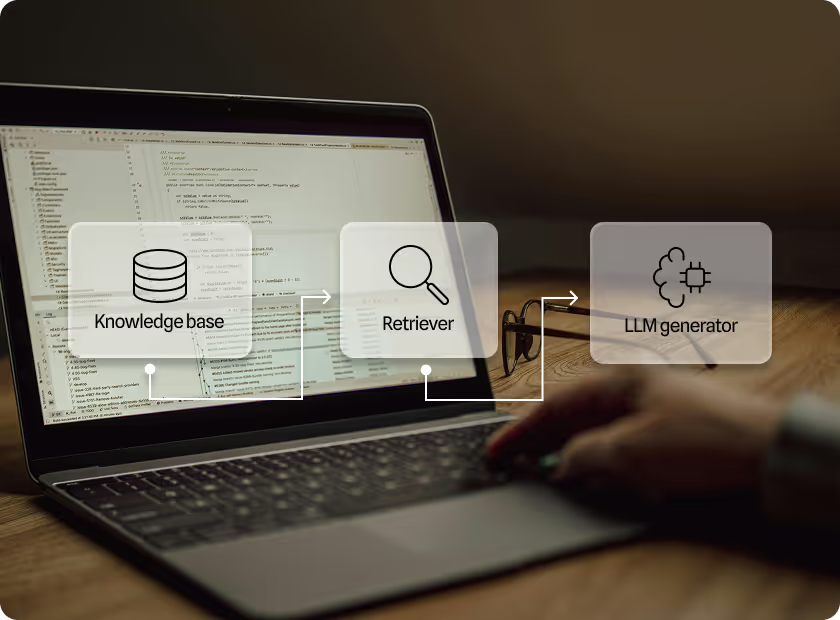
In its simplest form, the flow looks like this:
A query is issued
Relevant documents are retrieved
Those documents are passed into the model
The model generates an answer
This design assumes:
You know what to retrieve upfront
One retrieval step is enough
The context does not change mid-task
That assumption holds for FAQs and document search. It breaks down when the system needs to analyze, compare, or decide.
For example, a traditional RAG system can answer:
“What is our refund policy?”
It struggles with:
“Review this case, verify eligibility, check transaction history, confirm policy alignment, and decide whether to issue a refund.”
That second task requires multiple retrieval decisions, not one.
What Makes RAG “Agentic”
Agentic RAG introduces autonomy into the retrieval process itself.
Instead of treating retrieval as a one-time preprocessing step, the system treats it as an ongoing capability. Retrieval becomes something the agent can invoke repeatedly, selectively, and strategically as the task evolves.
In an agentic RAG workflow:
The system retrieves the initial context
Evaluates whether that information is sufficient
Decides what additional data is required
Switches sources if needed
Stops retrieving once confidence is high enough
The workflow continuously balances cost, relevance, and certainty.
A practical illustration is a sales or deal-desk workflow:
Start by retrieving the account history
If pricing is unclear, retrieve contract terms
If risk appears, retrieve compliance guidelines
Only then generate a recommendation
Pause for human approval before execution
The retrieval strategy adapts to the state of the task.
Tell us what you need. We will build, deploy and manage the AI Agent for you.
Agentic RAG vs Traditional RAG
The difference between traditional RAG and agentic RAG is not incremental. It is architectural.
Traditional RAG is query-centric:
One query
One retrieval
One answer
Agentic RAG is goal-centric:
One goal
Many possible retrievals
Decisions along the way
A helpful way to think about it:
Traditional RAG retrieves information
Agentic RAG decides what information is needed next
This distinction is why agentic RAG fits naturally inside agentic AI workflows, not simple chat interfaces.
The Core Building Blocks of an Agentic RAG Workflow
Agentic RAG works only when several components operate together as a system. Removing any one of them usually causes failures in production.
Goal-Driven Task Framing
Everything starts with a clearly defined outcome. Agentic RAG systems do not retrieve “just in case.” They retrieve to move closer to completion.
Effective goals include:
A clear success condition
Constraints and boundaries
A stopping rule
Criteria for escalation to humans
Without a goal, retrieval becomes noisy, expensive, and unfocused.
Reasoning Layer (LLMs)
Large language models interpret context, synthesize retrieved information, and propose next steps. They are excellent at understanding nuance and ambiguity.
However, they are not reliable executors. In agentic RAG systems, the model suggests actions, but does not enforce permissions or execute changes directly.
This separation is what allows agentic RAG to operate safely in enterprise environments.
Planning and Orchestration
Planning is what turns retrieval into a workflow rather than a lookup.
The planning layer:
Breaks the goal into stages
Decides when more information is needed
Adjusts the plan based on results
Knows when the task is complete
Without planning, RAG remains reactive. With planning, it becomes agentic.
Dynamic Retrieval Layer
Unlike classic RAG, agentic RAG does not rely on a single vector search.
Retrieval may involve:
Vector databases for unstructured knowledge
SQL queries for structured data
API calls to operational systems
Document lookups for policies or contracts
The system chooses which source to query next based on the task state, not a fixed template.
Memory and State Awareness
Agentic RAG workflows track what has already been retrieved and what conclusions have been drawn.
This prevents:
Duplicate lookups
Contradictory conclusions
Infinite retrieval loops
State awareness is what allows the workflow to feel coherent and intentional rather than repetitive.
Human-in-the-Loop Controls
In real organizations, fully autonomous decisions are rarely acceptable.
Agentic RAG workflows typically include:
Approval checkpoints for sensitive actions
Escalation paths for ambiguous cases
Clear audit logs of retrieved data and decisions
This design makes agentic RAG suitable for regulated and high-stakes environments.
How Agentic RAG Fits Into Agentic AI Workflows
Agentic RAG is not a standalone feature. It is a capability embedded within agentic workflows.
In practice:
The workflow defines the goal and boundaries
Agents reason and plan
Agentic RAG supplies the right knowledge at the right time
Humans provide oversight where required
This is why cloud and data platforms increasingly position RAG as the foundation for enterprise AI, and agentic RAG as the evolution needed for real execution.
Real-World Use Cases Where Agentic RAG Shines
Agentic RAG is most valuable when information is fragmented ,and decisions matter.
Common scenarios include:
Customer support investigations
Sales approvals and deal reviews
Compliance and risk analysis
Financial reconciliations
Knowledge-intensive operations
In each case, the system retrieves only what is necessary, when it is necessary, instead of flooding the model with irrelevant context.
RAG vs LLM: Why Both Are Needed
Large language models generate responses based on training data. They do not know what changed yesterday, what is private, or what is specific to your business.
RAG adds:
Freshness
Accuracy
Domain grounding
Agentic RAG adds:
Decision-making
Adaptation
Workflow awareness
Without RAG, models hallucinate. Without agentic RAG, systems stall when tasks become complex.
How to Choose: A Practical Decision Framework
Ask these five questions:
Is the task informational or outcome-driven?
Does it require multiple steps?
Does it touch multiple systems?
Does it require judgment?
Does it benefit from memory over time?
If you answer “yes” to more than two, you likely need an AI agent.
Common Types of RAG Systems in Practice
While there is no single official taxonomy, most real-world systems fall into a small number of patterns:
Simple or naive RAG for single-turn Q&A
Hybrid RAG combining keyword and vector search
Multi-source RAG pulling from several systems
Iterative RAG with repeated retrieval passes
Tool-augmented RAG that triggers actions
Self-reflective RAG that evaluates its own answers
Agentic RAG that coordinates all of the above toward a goal
Agentic RAG is the most comprehensive because it orchestrates retrieval rather than hard-coding it.
When Agentic RAG Makes Sense, and When It Doesn’t
Agentic RAG is a strong fit when:
Tasks involve investigation or judgment
Context evolves mid-process
Decisions have real consequences
Human review is required
It is unnecessary when:
Questions are static and simple
One lookup is always enough
Latency and cost must be minimal
Like any architecture, it should be used intentionally.
Final Takeaway
Agentic RAG transforms retrieval from a static input step into an intelligent, goal-driven capability.
If traditional RAG helps models answer questions, agentic RAG helps AI systems reason, decide, and act in real-world workflows.
That difference is why agentic RAG is increasingly central to modern agentic AI workflows, and why it is becoming the architecture enterprises trust for serious work.
Frequently Asked Questions
What is the RAG concept in AI?
RAG, or Retrieval-Augmented Generation, is a technique where AI systems retrieve external information and use it to ground their responses instead of relying solely on model training.
What is the difference between RAG and LLM?
An LLM generates text based on training data. RAG augments the model with retrieved external knowledge. Agentic RAG adds decision-making around when and what to retrieve across a workflow.
What are the 7 types of RAG?
Common RAG patterns include naive RAG, hybrid RAG, multi-source RAG, iterative RAG, tool-augmented RAG, self-reflective RAG, and agentic RAG, with agentic RAG being the most adaptive and workflow-aware.