AI Agent vs Chatbot: A Comprehensive Guide
AI agent vs chatbot explained clearly. Learn the real differences, use cases, examples, stats, and how businesses choose between chatbots and agentic AI.

Emily Davis
5 min read
AI agent vs chatbot explained clearly. Learn the real differences, use cases, examples, stats, and how businesses choose between chatbots and agentic AI.
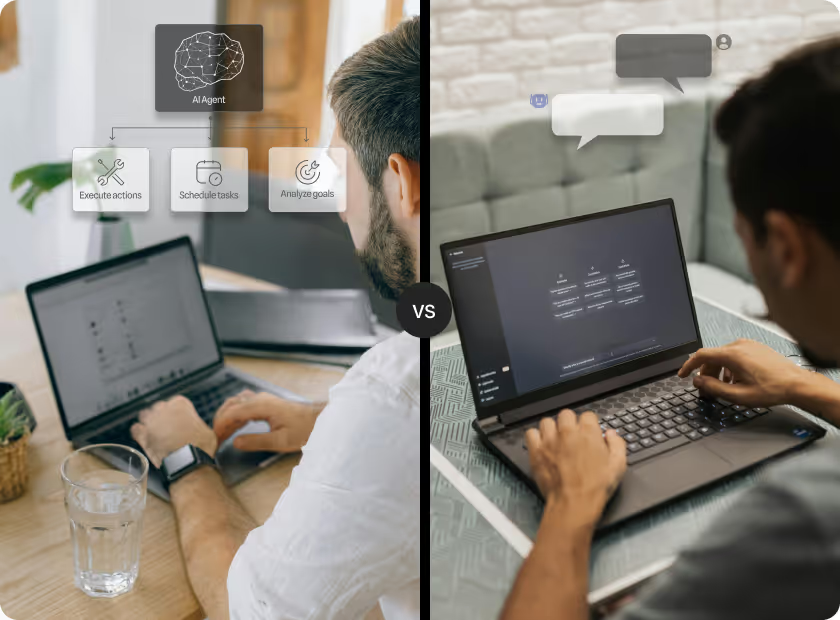
An AI agent is an autonomous system that plans and executes multi-step actions to achieve a goal, while a chatbot is a conversational system that only responds to user prompts.
Chatbots are reactive. They answer questions and stop. AI agents are goal-driven. They decide what to do next, interact with tools and systems, and continue working until the task is completed.
Chatbots focus on conversations, while AI agents focus on outcomes. Businesses use chatbots for FAQs and basic support, and AI agents for complex workflows like lead qualification, sales follow-ups, operations automation, and internal process execution.
Simply put, if an AI system only talks, it’s a chatbot. If it can decide what to do next and take action across tools, it’s an AI agent.
A chatbot is a conversational interface designed to respond to user inputs with answers, suggestions, or guided flows.
Modern chatbots often use large language models, but their behaviour remains fundamentally reactive.
Most chatbots fall into three categories:
Even advanced chatbots typically:
Chatbots work well when:
Common use cases:
According to Salesforce’s State of Service, a majority of service teams now use chatbots to handle routine inquiries before escalating to humans, improving response times and reducing agent workload.
Chatbots struggle when:
At that point, conversation alone is not enough.
An AI agent is an autonomous system that can reason, plan, and execute actions to achieve a defined goal.
Unlike chatbots, AI agents do not stop after responding.
They:
This is commonly referred to as agentic AI.
Reasoning engine
Usually, a large language model that understands goals and context.
Planning and orchestration
The agent determines what to do next, not just what to say.
Tool integration
Agents can update CRMs, query databases, trigger workflows, send emails, or create tickets.
Memory and context
Agents retain information across steps and sessions.
Guardrails and human-in-the-loop
Controls ensure safety, compliance, and escalation when needed.
McKinsey estimates that up to 30% of current work activities could be automated by 2030, particularly in knowledge-heavy functions.
AI agents are one of the most practical ways businesses are starting to capture that value.
This table summarizes the difference most clearly.
If the AI stops after replying, it’s a chatbot. If it continues to work, it’s an AI agent.
Chatbot
A reactive conversational system.
Conversational agent
Often a marketing term for a smarter-sounding chatbot. Still reactive.
AI agent
An autonomous system that plans, acts, and adapts.
Not every conversational agent is an AI agent.
Tell us what you need. We will build, deploy and manage the AI Agent for you.
“Virtual agent” is frequently used interchangeably with chatbot.
In most cases, it refers to:
A virtual agent becomes an AI agent only when it:
Chatbots are still the right choice when:
Examples:
For these cases, agentic complexity adds cost without value.
You should consider an AI agent when:
Gartner predicts that by 2028, at least 15% of daily work decisions will be made autonomously by AI agents, up from near zero today.
Chatbot scenario
A chatbot answers: “Do you integrate with Salesforce?” A salesperson manually follows up.
AI agent scenario
An AI agent:
Same interface. Radically different outcome.
Most organizations follow this progression:
Understanding this prevents over-engineering and under-delivering.
Ask these five questions:
If you answer “yes” to more than two, you likely need an AI agent.
Many teams try to turn chatbots into agents and hit walls around reliability, security, and ownership.
The JADA Squad builds production-grade AI agents:
Looking to deploy agents that fit into your workflows perfectly? Talk to our experts about building and managing customized AI Agents for your organization.
A chatbot responds to prompts, while an AI agent can plan and execute actions to achieve a goal. Chatbots stop after replying; AI agents continue working.
ChatGPT is primarily a chatbot. It becomes agent-like only when connected to tools, memory, and orchestration layers.
Yes, but only with additional components like planning logic, tool access, memory, guardrails, and human-in-the-loop.
No. Chatbots remain useful for simple interactions. AI agents handle complex workflows.
The suitability depends on the task at hand. Chatbots are ideal for FAQs. AI agents are better for multi-step, outcome-driven work.

